Astro · the knowledge layer
Where your thinking accumulates.
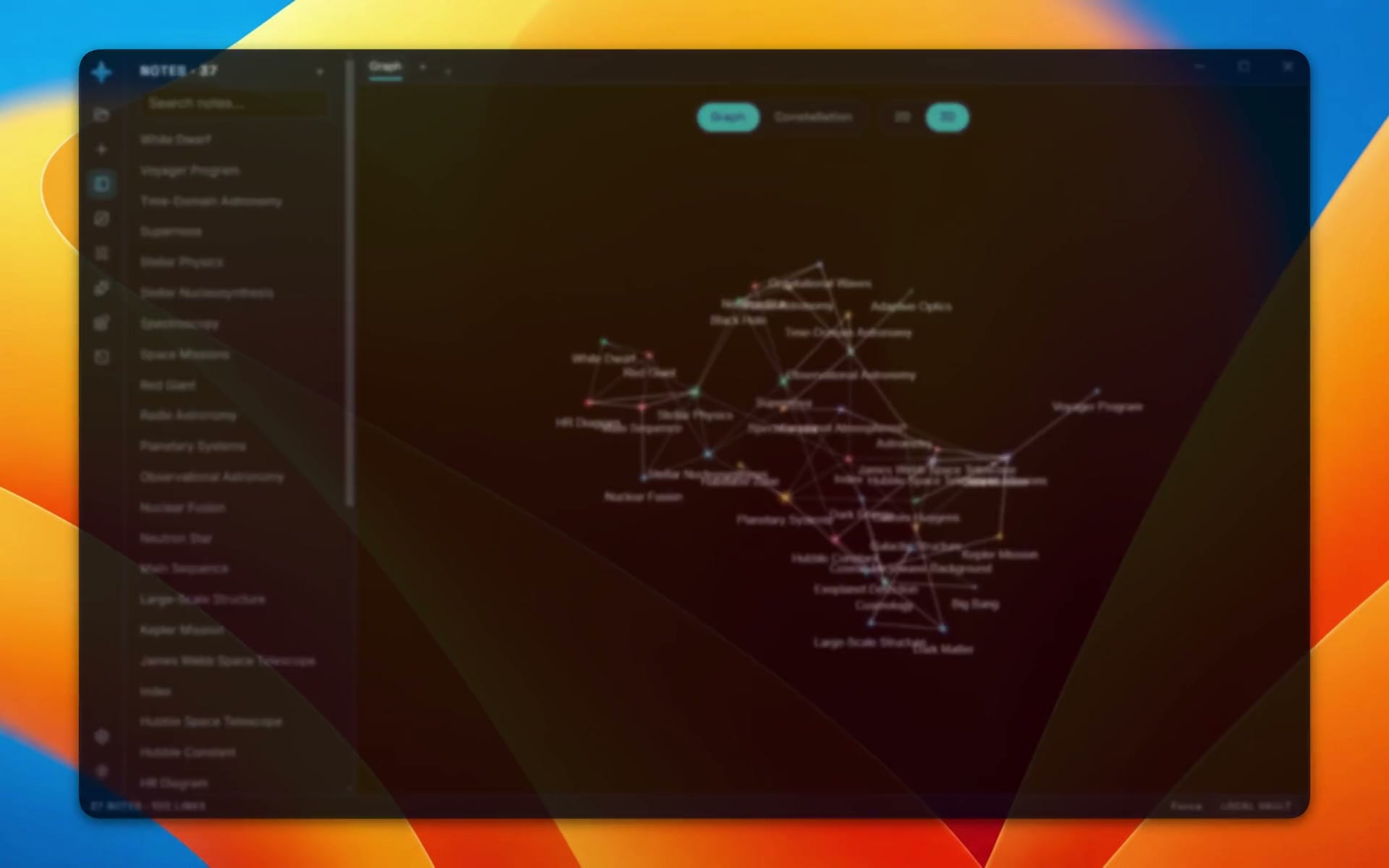
Astro is a workspace for notes, ideas, and connected information: stored as plain files on your disk, linked like a wiki, and edited directly inside a 3D graph. It was never meant to be only a notes app: from day one it's designed to be the memory Jarvis can consult.
v0.1.1, MIT licensed. The installer is unsigned, so Windows SmartScreen will warn on first run. macOS and Linux builds aren't published yet: you can build them from source.
Local first, actually
A vault is a folder. Your notes are plain Markdown files inside it, your canvases are JSON, and the whole thing is readable by any editor or script without running Astro. No database, no account required to think.
Wiki-links between ideas
Connect notes the way you connect thoughts. [[Double brackets]] turn a pile of files into a web of context. You can also just drag between two stars in the graph, no syntax required.
The graph is the workspace
Not a read-only map next to the real editor: the 3D graph is where you work. Click a star to open the note, drag it to move it, shift-drag between two stars to link them.
Constellation Mode
One toggle re-lays-out the same graph as a star chart, snapping your clusters onto the real IAU constellation figures. Same notes, same links, read as a sky.
Your keys, or none at all
AI is entirely opt-in. Bring an Anthropic or OpenAI-compatible key, point it at a local runtime like Ollama with no key at all, or skip AI completely. Keys live in your vault settings and go only to the provider you picked.
Agents can read it
A built-in MCP server exposes an open vault to any MCP-capable agent (Claude Code, Claude Desktop, Codex, Cursor, Goose), wired up from Settings with one click per client. No vault path is written into any config: the server follows whichever vault you have open.
Open & everywhere
Open source, and eventually on every device.
Astro is open source under MIT: anyone can use it, read the code, and improve it. Your notes stay local by default, as plain Markdown in a folder you chose.
Cloud sync, later
plannedFurther down the road there will be an optional cloud mode, so every device you own connects to the same memory: your phone, your laptop, and Jarvis all reading from one Astro. Optional means optional: local-first stays the default.
Agent skills
Two skills that make a vault an AI's memory, not just its data.
They ship with Astro, as plain Markdown with a YAML header. No install step, no runtime. They reach your vault the same way the Connections pane does, through the MCP server, and neither ever hardcodes a path.
Why it exists
A notes app that's really the memory of a system.
The plan: Jarvis reads your Astro (with your permission), so “write a summary of what I know about X” draws on months of your own notes, not a cold start. Astro and that connection are being built together.
See how Jarvis will use it →Measured, not just described
v0.1.0 lost notes. Here's the count, and the fix.
No head-to-head against Obsidian or Logseq exists yet, so this isn't that. What exists is a real before-and-after: what broke on a 364-note vault Astro wasn't built around, and what v0.1.1 actually fixed, counted rather than described.
Read the full report →